
Job costing software
Find out a job lost money while you can still do something about it.
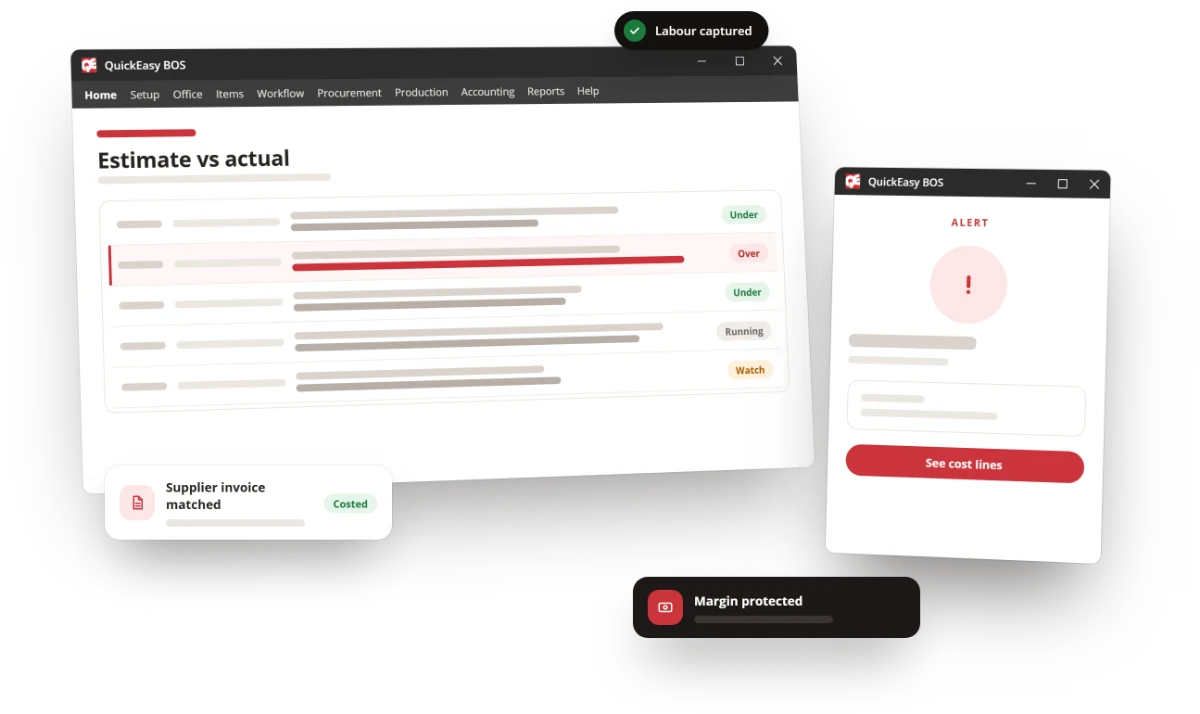
Estimate and actual on the same works order — material, labour, machine time and overhead — so you learn which work is worth taking instead of discovering it at year end.
The problem
Healthy margins at company level, losses job by job.
The estimate and the actual usually live in different places and never meet. That is the whole problem, and it hides in a perfectly reasonable-looking income statement.
Profitable jobs subsidising the rest
Report gross margin across the business and it looks fine. Report it per job and a meaningful share are underwater, funded by the ones that went well.
Rates from a better year
Labour rates taken from industry averages, efficiency assumed at its best, material priced from the last supplier quote. Each assumption is small; together they are the margin.
Machine time left out
The machine is often the most expensive resource in the building. Cost labour and material without it and the number looks right while quoting you into a loss.
Overhead allocated by guess
Burden can add 30 to 40 per cent on top of direct cost. Getting the allocation wrong is the most common way to lose margin without ever seeing it.
The benefit
Know which work to chase, and which to price differently.
Per-job truth, not an average
Every job carries its own estimate and its own actual, so the comparison is specific enough to act on.
Quotes that improve themselves
Booked hours and issued material feed back into the rates, so the next estimate is built on what actually happened.
Arguments settled with data
Whether a customer is worth keeping at that price stops being a matter of opinion.
The solution
The estimate and the actual meet on the works order.
Estimate
Material, labour, machine time and overhead priced from live rates, with waste and scrap allowances included rather than added at the end.
Book as you go
Manufacturing Data Collection captures real time and real material at the point of work, not reconstructed from memory at month end.
Compare
Estimate against actual on the same job, by cost element, so you can see which part of the number was wrong.
Feed it back
The historical data sharpens the rates the next estimate uses. This is the step that makes the other three worth doing.
What it costs against
Costing draws on the whole system.
- Bills of materials and routing
- The structure the estimate is built from, priced from live rates.
- Stock and landing costs
- Material valued on what it actually cost to land, not on the order price.
- Time and machine tracking
- Per-operator and per-machine, so machine time is a real cost rather than an assumption.
- Overhead recovery per machine
- Each machine recovers its own overhead, instead of one blended rate across the plant.
- NCR and rework
- Scrap and rework captured against the job that caused it.
- Analytics and reporting
- Estimate against actual by job, by customer and by product, with drill-down.
The close
Before you commit.
- "We already know our costs." Most businesses know their average cost. Job costing is about the distribution — which jobs sit either side of that average, and why.
- "The floor will not book time accurately." Booking happens at the point of work rather than on a timesheet at the end of the week, which is what makes the data usable.
- "Our overhead allocation is unusual." Recovery is configured per machine and per station to match how your plant actually absorbs cost.
- "Is costing an extra module?" No. Every module is in every subscription. The prices are published.
- "We are a job shop, not a factory." Make-to-order and one-off work is exactly where per-job costing pays, because there is no repeat product to average across.
Book a demo
Bring a job you finished recently and we will cost it in BOS alongside you — estimate, actual, and the gap between them.