
Estimating and quoting
The number you send is the number the job runs at.
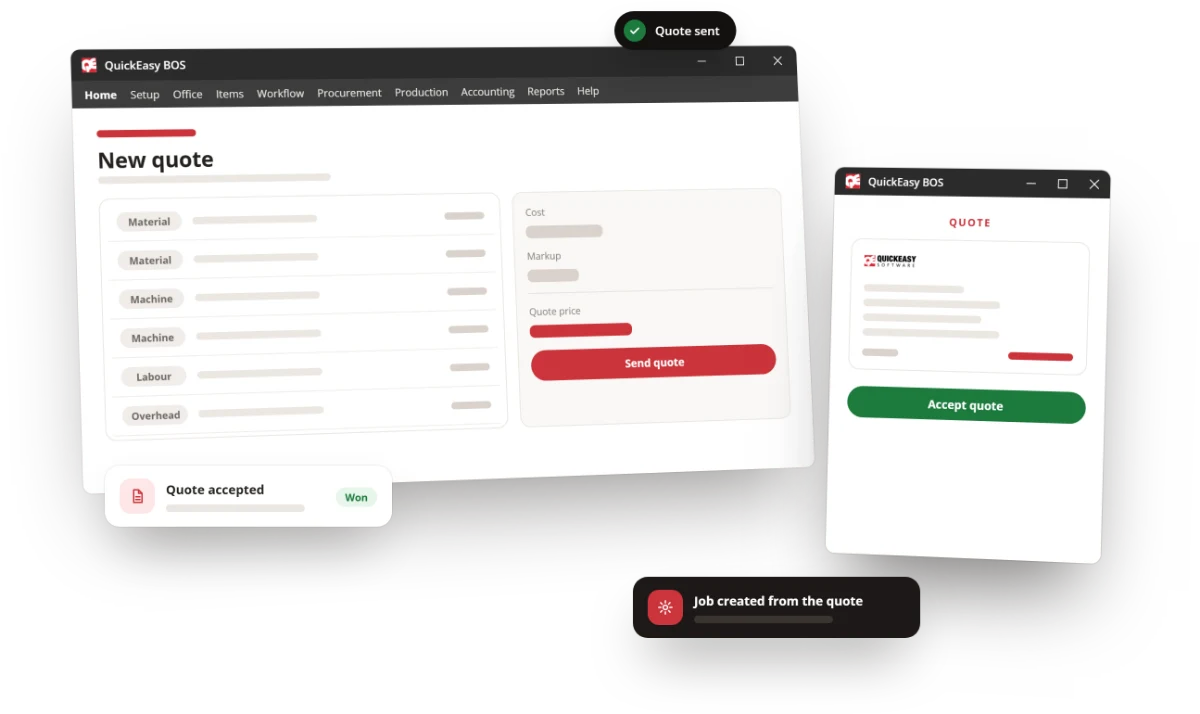
Estimates built from live material, labour, machine and overhead rates, in multiple quantities and currencies — fast enough to answer the enquiry the same day.
The problem
Quoting is either quick or accurate, and rarely both.
Which is why the fast quote is the one that loses money and the careful quote is the one that arrives after the customer has bought elsewhere.
Rates that expired quietly
The spreadsheet was right when it was written. Nothing tells you when material moved, so the price stays confident and wrong.
Every quote rebuilt from scratch
Similar work, priced fresh each time from memory, which makes speed and consistency compete with each other.
One person can do it properly
The judgement lives in a head rather than in a system, so quoting slows when they are on leave and stops when they leave.
No idea whether it was right
Without an actual to compare against, an estimate is never confirmed or corrected — so the same error is repeated for years.
The benefit
Answer faster, at a price you can stand behind.
Same-day answers
Products, prices, capacity and customer history are already in front of the estimator, so the quote does not wait for a calculation.
Consistent whoever quotes
The rates and rules are in the system, so two estimators quoting the same job land on the same number.
Break points you can show
Multi-quantity estimating puts 500, 1 000 and 5 000 in one document, which often sells a bigger run.
The solution
What goes into an estimate.
- Material from live rates, with multiple supplier prices per item and landing costs included.
- Labour and machine time from routings, each machine at its own speed and its own overhead recovery.
- Waste and scrap allowances calculated rather than added as a round percentage at the end.
- Multi-quantity and multi-currency in a single estimate, in the currency the customer buys in.
- A fixed module for print, packaging and signage that also prices wastage, ink consumption and sheet layout.
- Custom estimating for every other industry, configured to the transaction flow you already run.
- Full customer history attached, so the quote is priced with what this customer has bought and paid before in view.
After the quote
The estimate is the start of the record, not a separate document.
Accept it and it becomes the job card — which is what makes it possible to check later whether the estimate was any good.
- Order management
- The accepted quote becomes the job, carrying its specification and due date with it.
- Purchasing
- Material ordered against the job, with landing costs allocated automatically.
- Production
- Scheduled on a capacity-aware board, tracked through WIP.
- Job costing
- Actual against estimate when the job is done, by cost element.
- CRM
- Unlimited customer records and full quote history, kept when a rep leaves.
- Invoicing and accounting
- Invoice from the same record into full-house accounting.
The close
Before you commit.
- "Our estimating is too specific to us." That is what configuration is for — your machines, rates, waste factors and overhead recovery, not an industry average.
- "We quote in a spreadsheet and it is fast." It is fast until someone has to check it, or cover for the person who built it.
- "Is estimating an extra module?" No. Every module is in every subscription, including the fixed print, packaging and signage estimator. The prices are published.
- "Can it quote in other currencies?" Yes — multi-currency quoting with the cost still landing in your books in rands.
- "What if we get the rates wrong at the start?" Job costing corrects them. Estimate against actual is the feedback loop that makes the rates right over time.
Book a demo
Send us an enquiry you quoted recently and we will build the same estimate in BOS alongside you.