
Packaging ERP · Converters and packaging manufacturers
A few per cent of substrate decides whether the run paid.
Specification, costing, scheduling, stock and accounting for packaging converters — with the substrate, tooling and stage-by-stage waste arithmetic that sets the margin.
The problem
A carton is not a widget.
Four things a converter deals with daily that a general manufacturing system was never shaped for.
The product is a structure, not a part
Substrate, adhesive, ink, coating and lamination, each with its own dimension and cost, combining into a specification priced as a whole.
Tooling has to land on the right run
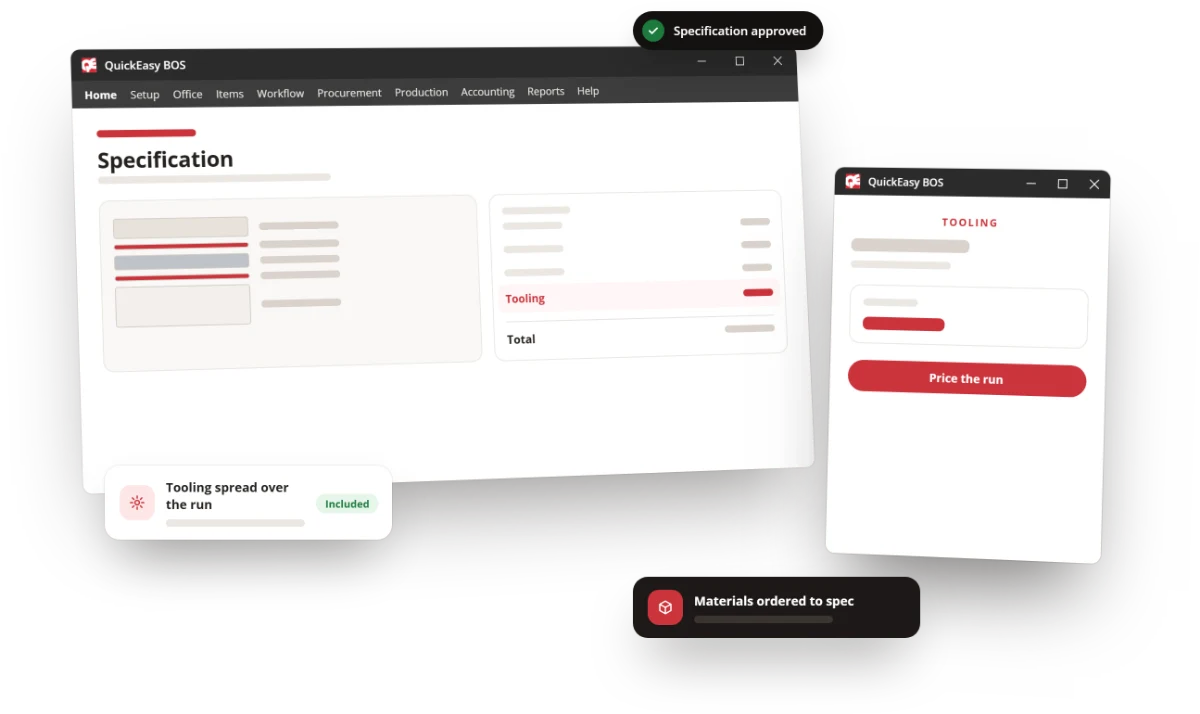
Dies, plates and cylinders are a real cost amortised over a quantity. Put it on the wrong one and you lose either the order or the margin.
Waste happens at every stage
Extrusion, lamination, printing, slitting, die-cutting — each takes its percentage. Costed as one blended figure, it is never right for any particular job.
Orders arrive as call-offs
A blanket order for the year, released in drops against a minimum quantity. A system that assumes one order equals one delivery cannot see what is left to run.
The benefit
Price the structure, not an approximation of it.
Waste costed per stage
Each converting stage carries its own factor, so the number reflects this job rather than an average of last year’s.
One rate change reprices everything
Substrates and adhesives are held once. Change a rate and every specification using it is right again.
You can see what is left to run
Call-offs netted against the blanket order, so the contract position is a fact rather than a spreadsheet someone maintains.
The solution
The specification is the cost model.
A fixed estimating module for printing, packaging and signage, sitting on a full bill-of-materials and routing engine.
- Multi-layer bills of materials. Substrate, adhesive, ink, coating and laminate held against the finished item and priced from live rates.
- Waste costed per stage. Calculated as part of the estimate, with the exact cost of unavoidable waste carried into the quote.
- Layout guidance. BOS shows you how to lay the job out to reduce wastage — on a long converting run, a better arrangement is money every hour.
- Tooling amortised across the quantity. Dies and plates priced into the run they belong to, with multi-quantity estimating to show the break points.
- Multiple units of measure. Buy by the tonne or the roll, consume by the square metre or the thousand, and let the system convert every time.
- Batch traceability. Finished product back to production batch, including raw materials — for the audit and for the recall you hope never happens.
- Call-offs against a blanket order. Order management and MRP that know how much of the contract is still to run.
Behind the estimate
The rest of the plant, on the same database.
- MRP and procurement
- Real demand netted against free stock and open orders. Multiple suppliers per item, landing costs automatic, EDI built in.
- Production scheduling
- Capacity-aware boards across converting stages, with shop-floor tracking and alerts.
- Warehouse management
- Multiple locations and bins, goods issues, receipts, returns and transfers, stock checks with approvals.
- Manufacturing data collection
- Time and material booked at the point of work, so actual cost builds as the run happens.
- Multi-entity accounting
- IFRS and GAAP compliant, multi-company, multi-currency — for converters running more than one plant.
- NCR and quality sign-off
- Non-conformance reporting and transaction approvals built in, not bolted on.
The close
What converters ask before they switch.
- "We do folding carton and some flexibles." One system. The bill of materials describes whatever structure the product has and the routing whatever stages it passes through — corrugated, carton, flexible and labels are configured, not coded.
- "Does it handle print as well as converting?" Yes — the same fixed estimating module covers printing, signage and packaging.
- "Can we keep our costing logic?" Machine speeds, waste factors and overhead recovery are set to your plant, not to an industry average.
- "What does it cost?" Month-to-month, per user, no capital outlay, every module included. The prices are published.
- "On our servers or yours?" Either. Your own network, or a managed cloud server we host, patch and back up daily.
Cost one of your own runs with us
Send us a job you converted recently — structure, tooling, waste and all — and we will build the specification in BOS alongside you.